Wednesday, October 24, 2012
Modular Buildings
In recent times, the use of modular buildings and homes are increasing in popularity; what was once written off as a cheap building is now being used in many different ways. See the Portable Buildings. These modular buildings are prefabricated structures that can be used as homes, offices, or classrooms, among many other things.
The building process of these modular structures, known as prefabricated construction is actually quite simple to follow. There are two main types of buildings that are prefabricated: modular buildings and mobile offices. Mobile offices, the first type of prefabricated building, are used most generally as temporary main offices for construction companies while they are working on site. modular buildings, on the other hand, are much more versatile due to the fact that they are often custom made in the vision of the buyer.
When comparing traditional buildings and modular buildings, the only difference is the area in which they are created; modular buildings are built in a factory controlled environment and traditional buildings are built on site, but both use the same exact building materials. During the building process, the modular building's floor plan is put into separate modules. To view more Click here. The exact floor plan of a modular building tends to vary due to the specifications of the buyer. The most common measurements, however, are usually eighteen feet wide and up to seventy-six feet long.
Transportation of the modular building is the next step in this process. The majority of modular buildings are brought from the factory to its destination on truck by a skilled commercial driver. A pre-prepared foundation is waiting for the modular building, which is lifted by crane and carefully placed on the foundation. The building is then fastened to the foundation and the building process is already done. With this method, the possibilities are endless; even buildings with many stories can be created by using several modular buildings placed on top of each other.
Nearly all of the modular buildings made today are made using the previously mentioned method. Ceilings and interior walls are also built into the modular building during the building process. These modular buildings also come with all the flooring and wiring ready to go. Most modular buildings consist of two modules that are seamlessly brought together at its destination site.
There are many uses for a finished modular building. Look at the Temporary school buildings. These uses can range from classrooms and daycare centers to schools and even dormitories. Aside from those uses they can also be used for office buildings, healthcare facilities, and clubhouses.

Prepare The Wedding Giddy
For couples who are planning a wedding, a lot of people is often confused with the details of their wedding party at a later date. The topics covered are also only about marriage preparation, no longer greet each other. That's what sometimes causes fights. You don't need to worry, all of which was entrusted to the torontodresses.com, so you won't be confused.
Monday, October 22, 2012
Check it out
Here's a wedding I did this past Fall. The bride and groom are such wonderful people and I am so glad that I've gotten to know them better. The bride Melinda has amazing taste and picked out wonderful food and decor. Which mind you, she made almost all the decorations herself! She owns a design and invitation company called , Revival Design Company (http://www.revivaldesigncompany.com/) please check it out because her prices and services are amazing! Melinda is from Nebraska and her husband Emil is from Brooklyn, NY....what a great mix of guests! It was a lot of fun and I truly enjoyed catering this wedding because everything was just so perfect! :)
Saturday, October 13, 2012
Spectrum Portable Buildings
Established in 1989 to cater for the increasing demand for portable accommodation. Originally focusing on the construction sector but then quickly diversifying to service hospitals, schools, sports & leisure and telecommunications. In fact wherever there is a need for instant space Spectrum Portable Buildings has the instant solution.
The company is family owned and run and has enjoyed considerable expansion in recent years. Managing Director Norman Smyth and his team have over 40 years experience in supplying portable accommodation and with that wealth and knowledge in the business they can find cost effective solutions to space requirements that others don't even consider.
Spectrum Portable Buildings provide a full range of services nationwide including design & build options from planning to turnkey. With hundreds of satisfied clients we are confident we can meet your requirements.
Container and Modular Building Solutions Include
Standard / Jackleg Cabins
Antivandal Cabins
Modular Buildings
Storage Containers
Steel Arch Buildings
Special / Custom Built Units
Sunday, October 7, 2012

Tuesday, October 2, 2012
Home Schooling 101

Why
bother? Well, if you are thinking it is a bother, you might re-think
your decision right there. To educate your child at home is not a
bother, but a wonderful, richly rewarding experience that benefits you
and your child. So, take the "bother" word from your vocabulary if you
really would like that opportunity. Yes, this is your opportunity and
your child's opportunity.
If you are a stay-at-home mom or dad,
then you have the opportunity to have wonderful learning experiences by
home-schooling your child. In most states, home-schooling is legal, a
legal option. There are some guidelines and rules and regulations that
you need to follow, but after that everything rocks! (In some states,
there are a certain amount of days that you have to notify the Board of
Education that you intend to home-school your child).
You cannot
simply keep your child from school and decide to home school. You must,
almost always notify the School Board or the Board of Education. You
can find out the rules and regulations through your government officials
or through some wonderful home-schooling magazines and literature.
Once you find out the rules and regulations, you are set to go.
Are there benefits to home-schooling?
Time, Balance, Growth & Togetherness

You
will have more time for each other. You can make practically any
life-lesson an education lesson. Going to the supermarket or going to a
department store is a lesson in buying, purchasing, finances and
product comparison. Going to a fast food place is a lesson in food,
health, and in purchasing and even a lesson in customer service. The
fast food process shows the children very valuable marketing lessons.
So things in every day life add to your home schooling experience.
Good Education
Another
benefit is a great education. You see first hand what your child is
learning without the need for PTA meetings and without the need for a
strangers' report on your child's progress. You choose your child's
education. If you want to teach your child spiritual lessons, you can
do that. You can teach religion as history and history as religious
lessons. (Look at all the Christians in history and look at the impact
they made in our land). You can teach fun science lessons and math
lessons. A trip to the bank and to the ATM will be a great business
math lesson.

What are the problems related to home-schooling?
There are few problems to home-schooling, and these are some:
Your child might miss the classmates if your child started out with regular education and now switched to home-schooling.
How do you solve those problems?
The
way to overcome this is to have your child interact as much as possible
with the children from the other schools. Invite the children (with
parents' permission) to come on some day trips with you . Or invite them
over after school. Have your child enroll in a hobby that he or she
likes . (Children take up piano or bowling, or art , and in these
hobbies the children make new friends and have interaction with children
their own age). Use your own imagination and you will find ways to
have your child interact with other children and still be home-schooled.
Testing

Stigma
Years
ago, there used to be a stigma attached to home-schooling. Years ago,
most times farmers and poor people and migrant workers home-schooled.
Sometimes children and even adults made fun of home-schoolers. But
today, that is all changed around remarkably. And this was especially
noted when one year, the home-schooled child won the National Spelling
Bee on national tv, proving that she was the best speller in the nation.
Even after that so many came forward on television stating they had
been home-schooled and were now attending college or had graduated from
conventional colleges.

What is an "Alternative School?"

In general, alternative schools have more complete educational and developmental objectives than standard schools. They often have program fundamentals that focus on improving student self-esteem, fostering growth of individuality, and enhancing social skills. Alternative schools are more flexible in their administration and organization, which allows for more variety in educational programs.
Once available primarily for disruptive students and those at risk for dropping out of a traditional school environment, alternative schools have expanded significantly in purpose as educators, parents, and wider communities recognize that many adolescents may not learn successfully in a traditional school environment. For children and adolescents with behavioral and psychological issues, such as depression, personality disorders, substance use and abuse, and violence, alternative schools may provide a safer therapeutic environment and more individualized attention than traditional schools.
For children and adolescents with certain medical conditions and learning challenges such as attention deficit hyperactivity disorder (ADHD), Asperger's syndrome, and dyslexia, alternative schools may provide combined clinical and education services in one place to ease learning. Alternative school structure and curriculum varies depending on the educational goals and desired student population. Alternative schools may not be accessible or available locally and may require additional daily travel or residential boarding by the student. Usually, local alternatives to public schools do not require a monthly tuition, while private schools do require parents to pay a monthly tuition for student attendance. A number of different types of alternative schools exist, including the following:
o emotional growth boarding schools
o independent private schools
o local alternatives to public schools, for example, at-risk programs, charter schools, magnet schools,
o special-needs day schools
o therapeutic wilderness programs

For children and adolescents identified as "at-risk" by the public school district, alternative programs may be available.
Usually, at-risk alternative programs are offered at a special location within the public school district or at a location that is accessible to and serves multiple public schools (e.g., a county-wide program).
At-risk students usually have undergone school psychological and behavioral evaluations that identify them as requiring specialized attention not available in the traditional school environment.
Suitable programs may include emotionally disturbed, oppositional, and disruptive students and offer smaller classes, specially trained staff, and closer supervision. Some programs may be dedicated to serving a particular group of at-risk students, such as pregnant teens and teen mothers.

Private schools require that parents pay tuition and usually have a competitive admissions process requiring students to complete an application and interview. Private schools usually emphasize academic and/or athletic achievement, and student acceptance is based on academic and athletic potential, as well as enthusiasm for being active in school community life. Private schools have smaller classes, a more structured learning environment, a variety of extracurricular activities, and individualized opportunities for developing student creativity and intellect. Therapeutic wilderness programs involve group and individual therapy in an outdoor adventure setting. More and more are now including some academics as parents have their students in these programs all throughout the year and not just in the summer months.

Monday, October 1, 2012
Clinton and Bush -- The Cause of School Shootings

Note that I am only including intentional shootings, not accidental gun discharges. Nor am I counting the incidents of carnage involving the use of a car (as in California in 1999) or any other type of instrument. The list of school shootings during the reign of Clinton is as follows:
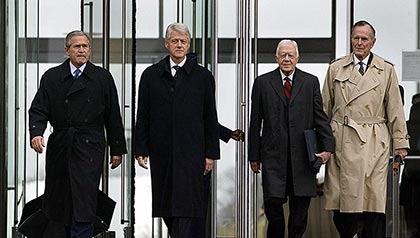
May 1, 1992. Brooklyn, New York, high school, 4 dead, 9 wounded.
January 12, 1993. Miami, Florida, high school, 1 dead.
January 18, 1993. Grayson, Kentucky, high school, 2 dead.
March 25, 1993. St. Louis, Missouri, high school, 1 wounded.
May 24, 1993. Pennsburg, Pennsylvania, high school, 1 dead.
April 8, 1994. Maryland high school, 1 wounded.
February 2, 1996. Moses Lake, Washington, junior high school, 3 dead,1 wounded.
April 15,1996. Washington, District of Columbia, high school, 1 wounded.
February 19, 1997. Bethel, Alaska, high school, 2 dead, 2 wounded.
May 1, 1997. New York City, New York, high school, 1 wounded.
October 1, 1997. Pearl, Mississippi, high school, 2 dead, 7 wounded.
December 1, 1997. West Peducah, Kentucky, high school, 3 dead, 5 wounded.
December 15, 1997. Stamps, Arkansas, 2 wounded.
March 24, 1998. Jonesboro, Arkansas, middle school, 5 dead, 10 wounded.
April 24, 1998. Edinboro, Pennsylvania, middle school, 1 dead.
April 28, 1998. Pomona, California, elementary school, 2 dead, 1 wounded.
May 19, 1998. Fayetteville, Tennessee, high school, 1 dead.
May 21, 1998. Springfield, Oregon, high school, 2 dead.

April 20, 1999. Littleton, Colorado, high school, 15 dead, 28 wounded.
May 20, 1999. Conyers, Georgia, high school, 6 wounded.
November 19, 1999. Deming, New Mexico, middle school, 1 dead.
December 6, 1999. Fort Gibson, Oklahoma, middle school, 4 wounded.
February 29, 2000. Mount Morris Township, Michigan, elementary school, 1 dead.
May 26, 2000. Lake Worth, Florida, middle school, 1 dead.
September 26, 2000. New Orleans, Carter G. Woodson Middle School, 2 wounded.
August 28, 2000. Fayetteville, Arkansas, University of Arkansas, 2 dead.
So the "body count" during Clinton's war on America is fifty one dead and eighty three wounded.
The list of school shootings prior to and after Clinton are as follows:
August 1, 1966. Austin, Texas, college, 14 dead.

March 5, 2001. Santee, California, high school, 2 dead 13 wounded.
March 7, 2001. Williamsport, Pennsylvania, high school, 1 wounded.
March 22, 2001. El Cajon, California, high school, 5 wounded.
March 30, 2001. Gary, Indiana, high school, 1 dead.
January 15, 2002. New York, New York, 2 wounded.
January 16, 2002. Grungy, Virginia, law school, 3 dead, 3 wounded.
2003, Case Western Reserve University Law School, 1 dead, 2 wounded.
Jan 10, 2003, Orlando, Florida, middle school, 1 dead.
September 2003, Cold Spring, MN, high School, 2 dead.
March 21, 2005, Bemidji, MN, high school, 10 dead, 15 wounded.
October 20, 2005, Saginaw, MI, high school, 1 wounded.
November 8, 2005, Jacksboro, TN, high school, 1 dead, 2 wounded.
The "body count" for all non Clinton school shootings is forty two dead and thirty six wounded.

Excelling Arizona Schools Named for 2004-2005 School Year

o AIMS Scores -- Measures reading, language arts and mathematics for elementary schools; and reading, writing and mathematics for high schools.
o MAP -- Measure of Academic Progress for schools, where students scores for AIMS and SATs are compared to the state average.
o Graduation/Dropout Rates -- Used for the high schools.
o AYP -- Adequate Yearly Progress measures student proficiency in the state's academic standards of reading and mathematics over time.
The AZ LEARNS program for the Arizona schools categorizes schools on a graded scale as either:
o Failing to meet academic standards,
o Underperforming,
o Performing,
o Highly Performing, or
o Excelling.
The Arizona schools for the 2004-2005 school year that were named Excelling are (listed by district/charter and school):
Arizona schools' Academy of Tucson, Inc. Academy of Tucson Middle School
Arizona schools' Alhambra Elementary District Alhambra Traditional School
Arizona schools' Allen-Cochran Enterprises, Inc. Center for Educational Excellence
Arizona schools' Amphitheater Unified District Canyon Del Oro High School
Richard B. Whlson Jr. School
Winifred Harelson Elementary School
Arizona schools' Arizona School for the Arts Arizona School for the Arts -- both
elementary & high school
Arizona schools' BASIS School, Inc. BASIS Tucson -- both elementary &
high school
Arizona schools' Basis School, Inc. -- Scottsdale Basis Scottsdale
Arizona schools' Benchmark School, Inc. Benchmark School

both Gilbert and Mesa
Arizona schools' Bright Beginnings School, Inc. Bright Beginnings School #1
Arizona schools' CASY Country Day School CASY Country Day School #1
Arizona schools' Catalina Foothills Unified District Canyon View Elementary School
Catalina Foothills High School
Esperero Canyon Middle School
Manzanita School
Orange Grove Middle School
Sunrise Drive Elementary School
Ventana Vista Elementary School
Arizona schools' Cave Creek Unified District Cactus Shadows High School/PSH
Desert Arroyo Middle School
Desert Sun Elementary School
Arizona schools' Challenge School, Inc. Challenge Charter School
Arizona schools' Chandler Unified District Anna Marie Jacobson Elementary
School
Basha Elementary
Basha High School
Chandler High School
Chandler Traditional Academy --
Liberty Campus

Jane D. Hull Elementary
John M. Andersen Elementary School
Robert and Danell Tarwater
Elementary
Sanborn Elementary School
Santan K-8
Shumway Elementary School
Arizona schools' Crane Elementary District Ronald Reagan Fundamental School
Arizona schools' D.W. Higgins Institute D.W. Higgins Institute
Arizona schools' Daisy Education Corporation Sonoran Science Academy -- both elementary & high school
Arizona schools' Deer Valley Unified District Arrowhead Elementary School
Cooper Creek Elementary

Greenbrier Elementary School
Hillcrest Middle School
Legend Springs Elementary
Mountain Ridge High School
Sierra Verde Elementary
Arizona schools' East Valley Academy East Valley Academy
Arizona schools' Edu-Prize, Inc. Edu-Prize
Arizona schools' Flagstaff Junior Academy Flagstaff Junior Academy
Arizona schools' Flagstaff Unified District Charles W. Sechrist Elementary School
Flagstaff Middle School
Manuel DeMiguel Elementary School
Thomas M. Knoles Elementary School
Arizona schools' Foothills Academy Foothills Academy -- both elementary & high school
Arizona schools' Fort Huachuca Accommodation District Colonel Smith Middle School
Arizona schools' Fountain Hills Unified District McDowell Mountain Elementary School
Arizona schools' Franklin Phonetic Primary School, Inc. Franklin Phonetic Primary School
Arizona schools' Gilbert Unified District Ashland Elementary
Carol Rae Ranch Elementary
Desert Ridge High
Finley Farms Elementary

GPS Traditional Academy
Greenfield Junior High School
Highland High School
Highland Junior High School
Islands Elementary School
Patterson Elementary School
Playa del Rey Elementary School
Sonoma Ranch Elementary School
Spectrum Elementary
Technology and Leadership Academy
Towne Meadows Elementary School
Val Vista Lakes Elementary School
Subscribe to:
Posts (Atom)